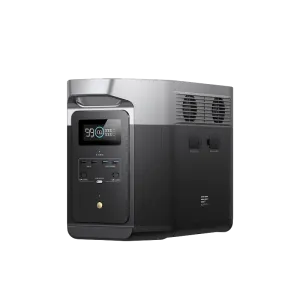
DELTA 2 Max specs
| Brand | EcoFlow |
|---|---|
| Released | 2023 |
| Capacity | 2,048Wh |
| Continuous output | 2,400W |
| Surge output | 4,800W |
| Battery | LiFePO4, 3,000 cycles to 80% |
| Max solar input | 1,000W |
| AC recharge | ~1.4 h (AC) |
| Weight | 50 lb |
| Expandable to | 6,144Wh |
| UPS switchover | 20ms |
| Price tier | $$ Mid-range ($700–$1,500). See Amazon for today's price. |
Specs and street prices compiled October 2026 from manufacturer pages and dated retailer listings — prices move weekly, so confirm on the retailer page before buying.
The EcoFlow DELTA 2 Max is the default answer in the 2kWh class: 2048Wh, 2400W of output, 50 lb — the lightest 2kWh station we track — with EcoFlow’s best-in-class app and an expansion path to 6.1kWh.
Check current price: EcoFlow DELTA 2 Max.
Who the DELTA 2 Max is for (and who should skip it)
Buy it if you want the safe mainstream pick: enough capacity for a full day of essentials, enough output for anything short of 240V, light enough to actually carry to the campsite. It’s the unit we recommend to first-time buyers who don’t want to think about it again.
Skip it if solar speed is the priority — 1000W combined input trails the AC200L (1200W) and F3000 (2400W). Skip it if you want the absolute lowest price; the Anker C2000 Gen 2 undercuts it on sale. And skip it if you plan to cycle it hard every day — the Elite 200 V2’s 6000-cycle battery is the marathon pick.
Output and surge
2400W continuous with a 4800W surge rating is generous — it starts fridge compressors and runs microwaves, kettles, and most job-site tools simultaneously. Six AC outlets is the most in this class.
Real-world runtime examples
Usable capacity is ~85% of 2048Wh, about 1741Wh:
- Full-size fridge (~150W avg): ~11.6 hours.
- Home office (~200W, laptop + monitor + router): ~8.7 hours — a full remote workday.
- Microwave (~1000W): ~1.7 hours of cooking time.
- Two phones + tablet + drone batteries (~100W): ~17 hours of charging for a family trip.
Add one extra battery (4096Wh total) and the fridge stretches past 23 hours — an easy two-day outage buffer with a modest solar top-up.
The EcoFlow app advantage
Scheduling, automations, storm alerts, time-of-use modes — EcoFlow’s software is meaningfully ahead of BLUETTI and Jackery. If you plan to use the station daily (not just for outages), the app is a real reason to pick this platform.
How it compares
Versus the Anker C2000 Gen 2: Anker is lighter, cheaper on sale and rated for more cycles; EcoFlow has more outlets and better software. Versus the Elite 200 V2: BLUETTI wins on battery longevity; EcoFlow wins on expansion and weight. Run your loads through the RV sizer to see if 2kWh is your size, or read what size power station for the full framework.
The 43-minute party trick
Combine AC and solar inputs (up to 2400W total) and the 2 Max hits 80% in about 43 minutes — the fastest hybrid recharge in its class. In practice that means a storm warning at 2pm and a full battery by dinner, even starting from empty. Wall-only is still a quick 1.4 hours. This is the station for people who recharge between outages rather than living off solar.
Long-term ownership
The 3000-cycle LFP pack is the standard 10-year rating here — shorter than Anker’s 4000 or BLUETTI’s 6000, but fine for outage-plus-camping duty at a few dozen cycles a year. EcoFlow’s 5-year warranty matches the class. The one real aging concern is the app dependency: automations and storm alerts need the app and cloud account, so keep firmware updated and the Wi-Fi credentials current.
Transfer switch basics
The 2 Max’s most underused feature is feeding a manual transfer switch: an electrician wires 4–6 essential circuits (fridge, freezer, lights, modem, sump pump) to a sub-panel the station feeds at 2400W. During an outage you flip one switch instead of running extension cords. Total cost is a few hundred dollars for the switch plus installation — cheap compared to the station — and it turns a portable box into a semi-permanent backup system.