SOLIX C1000 specs
| Brand | Anker |
|---|---|
| Released | 2024 |
| Capacity | 1,056Wh |
| Continuous output | 1,800W |
| Surge output | 2,400W |
| Battery | LiFePO4, 3,000 cycles to 80% |
| Max solar input | 600W |
| AC recharge | 0–100% in 58 min (AC) |
| Weight | 28.4 lb |
| Expandable to | 2,112Wh |
| UPS switchover | 20ms |
| Price tier | $ Budget (under $700). See Amazon for today's price. |
- Street price is often $400–$500 on sale; $999 is list.
- SurgePad allows up to 2400W for resistive loads.
Specs and street prices compiled October 2026 from manufacturer pages and dated retailer listings — prices move weekly, so confirm on the retailer page before buying.
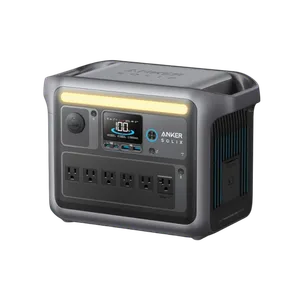
The Anker SOLIX C1000 is the gateway power station: 1056Wh, a real 1800W inverter, and a 58-minute full recharge — frequently on sale under $500, which makes it the cheapest credible way into the category.
Check current price: Anker SOLIX C1000.
Who the C1000 is for (and who should skip it)
Buy it as a first station for camping, tailgating and short outages. It runs a fridge for most of a day, charges everything you own, and recharges faster than anything near its price.
Skip it if you need genuine home backup — 1056Wh is one fridge-day. That’s 2kWh territory, not 1kWh. Skip it if your loads need 2000W+ continuous — the SurgePad trick covers resistive loads only, and a circular saw or compressor will trip it.
Real-world runtime examples
Usable capacity is ~85% of 1056Wh, about 898Wh:
- 12V camping fridge (~45W): ~20 hours — a full day and night at the campsite.
- Laptop (~65W): ~13.8 hours — two full workdays of charging.
- Coffee maker (~1200W): ~45 minutes of brewing — a long weekend of mornings.
- String lights + phones + speaker (~50W): ~18 hours — an entire evening of tailgating.
The 58-minute recharge
This is the C1000’s superpower: 1300W AC input fills the battery in under an hour. Forgot to charge before the trip? Plug it in while you pack. No other budget station recharges this fast. Solar takes up to 600W — two 200W panels refill it in about 3 peak sun hours.
Output
1800W continuous (2400W SurgePad for resistive loads) runs microwaves, coffee makers, electric griddles and most power tools — far beyond what 1kWh boxes offered a few years ago. Eleven ports including 100W USB-C.
How it compares
Versus the EcoFlow DELTA 3 Plus: EcoFlow gives you 2400W and better expansion for roughly double the sale price; Anker wins on value. Versus the DJI Power 1000: DJI wins for creators (dual 140W USB-C); Anker wins on price, recharge speed and expandability. See our budget roundup and the EcoFlow vs Anker vs Jackery ecosystem comparison.
The tailgate and campsite playbook
The C1000’s real habitat is the weekend: 28.4 lb, one-hand carry, eleven ports. A 12V fridge, two phones, a Bluetooth speaker and string lights draw ~150W combined — that’s about 6 hours per charge, or a full evening with the fridge pre-chilled. Recharge from the car on the drive home (the 12V input is slow but steady) or from the wall in under an hour when you get back.
SurgePad, explained honestly
SurgePad lets the 1800W inverter push up to 2400W into resistive loads — heating elements, basically. A 2000W kettle works; a 2000W circular saw probably trips it, because motors aren’t resistive. The battery still drains at the full 2400W rate: 898 usable watt-hours means 2400W lasts about 22 minutes. SurgePad is a “finish the job” feature, not a bigger battery.
Warranty and what wears out first
The C1000 carries Anker’s 5-year warranty — the class standard. In practice, what wears out on budget stations isn’t the LFP cells (3000+ cycles is a decade of weekend use) but the moving and stressed parts: cooling fans under sustained 1500W+ loads, and USB ports from years of plugging. Run it at 80% of rated output or less and keep the vents clear, and there’s little reason it won’t last the warranty twice over.
Bottom line
The C1000 is the cheapest credible entry into portable power: a real 1800W inverter, the fastest recharge in its class, and frequent sub-$500 sales. Buy it as a first station or a campsite companion; buy 2kWh when you need real home backup.
Featured in our guides
- RV & Vanlife Power Sizing: How Many Watt-Hours Do You Actually Need? (2026)
- What Size Power Station to Run a Refrigerator? Runtime Math That Actually Works (2026)
- What Size Power Station Do I Need? Capacity vs Output Explained (2026)
- Best Budget Portable Power Stations Under $1,000 (2026)