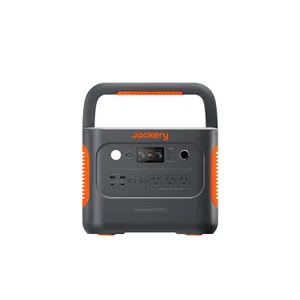
Explorer 1000 Plus specs
| Brand | Jackery |
|---|---|
| Released | 2023 |
| Capacity | 1,264Wh |
| Continuous output | 2,000W |
| Surge output | 4,000W |
| Battery | LiFePO4, 4,000 cycles to 80% |
| Max solar input | 400W |
| AC recharge | ~100 min to 80% (AC) |
| Weight | 32 lb |
| Expandable to | 5,056Wh |
| Price tier | $$ Mid-range ($700–$1,500). See Amazon for today's price. |
- 400W solar input is the lowest here — pair with Jackery's own panels for best results.
Specs and street prices compiled October 2026 from manufacturer pages and dated retailer listings — prices move weekly, so confirm on the retailer page before buying.
The Jackery Explorer 1000 Plus makes sense inside the Jackery ecosystem: 1264Wh, 2000W of output, expansion to 5kWh, and the deepest bench of matching SolarSaga panels and accessories in the business.
Check current price: Jackery Explorer 1000 Plus.
Who the 1000 Plus is for (and who should skip it)
Buy it if you’re already in Jackery’s world — panels, cases and expansion batteries that all click together — or if you value the simplest app and the most beginner-friendly experience here. It’s also the honest pick if you want to start at ~1.25kWh and grow toward home backup later via expansion batteries.
Skip it on pure specs-per-dollar: the Anker C1000 beats it on price, recharge speed and solar input. The 400W solar cap is the hardest spec to defend. And skip it if you need 2400W for spiky tools — the DELTA 3 Plus has the bigger inverter.
The ecosystem advantage
This is Jackery’s real moat: SolarSaga panels from 100W to 500W, expansion batteries, parallel kits, and a huge owner community. If you want one brand for everything and zero adapter anxiety, it matters.
Real-world runtime examples
Usable capacity is ~85% of 1264Wh, about 1074Wh:
- Full-size fridge (~150W avg): ~7 hours — a short outage buffer.
- 12V camping fridge (~45W): ~24 hours — a full day off-grid.
- CPAP machine (~60W): ~18 hours — two to three nights.
- Electric grill (~1500W): ~43 minutes of cooking — plenty for a campsite meal.
Add one 1264Wh expansion pack and every number roughly doubles — the 1000 Plus grows into a genuine 2.5kWh backup box.
Output and battery
2000W continuous with 4000W surge is plenty for camping kitchens and short outages. The LiFePO4 pack carries Jackery’s 10-year lifespan rating and a 5-year warranty with registration.
How it compares
Versus the Anker C1000: Anker wins on nearly every spec and usually on price; Jackery wins on ecosystem and expansion ceiling. Versus the DELTA 3 Plus: EcoFlow wins on output and recharge; Jackery wins on simplicity. If you’re deciding between ecosystems, our EcoFlow vs Anker vs Jackery comparison lays out the trade-offs, and rv-vanlife power sizing covers the campsite math.
The beginner’s ramp
Jackery’s real advantage is the shallowest learning curve here: unbox, plug in, the app shows one big number. No MPPT voltage windows to calculate, no UPS modes to configure. For a first station bought by someone who will never read a manual, that simplicity has value the spec sheet doesn’t capture — fewer settings means fewer ways to misconfigure it.
Solar: the honest math
400W of panels (~320W real-world) refill the 1264Wh battery in about 4 peak sun hours — a full sunny day, basically. Two 200W SolarSaga panels are the practical setup; four maxes the input. If your use case is “charge at home, use at camp,” the slow solar doesn’t matter. If it’s “live off solar for a week,” the Anker C1000’s 600W input or a 2kWh-class station is the better tool.
When to step up to the 2000 Plus
The honest upgrade trigger is runtime, not watts: if the 1000 Plus’s 7-hour fridge runtime keeps leaving you short, the Explorer 2000 Plus nearly doubles the base capacity (2043Wh), adds 1000W of output headroom, and triples the solar cap to 1200W. The price jump is real ($1000+ more), but so is the jump from “short outage box” to “day-long backup.” If 1264Wh covers your loads with margin, stay put and spend the difference on panels.
Bottom line
The 1000 Plus is the easiest first station here and the natural on-ramp to Jackery’s ecosystem, with expansion to 5kWh when you outgrow the base. Buy it for simplicity; buy on specs and the Anker C1000 usually wins.