Power 1000 specs
| Brand | DJI |
|---|---|
| Released | 2024 |
| Capacity | 1,024Wh |
| Continuous output | 2,200W |
| Surge output | 4,400W |
| Battery | LiFePO4, 4,000 cycles to 80% |
| Max solar input | 800W |
| AC recharge | 0–100% in 70 min (AC) |
| Weight | 29 lb |
| UPS switchover | 20ms |
| Price tier | $ Budget (under $700). See Amazon for today's price. |
- DJI rates 4000 cycles to 70% capacity, not the usual 80% — not directly comparable.
- Solar charging needs the add-on MPPT module; dual 140W USB-C is best-in-class for creators.
Specs and street prices compiled October 2026 from manufacturer pages and dated retailer listings — prices move weekly, so confirm on the retailer page before buying.
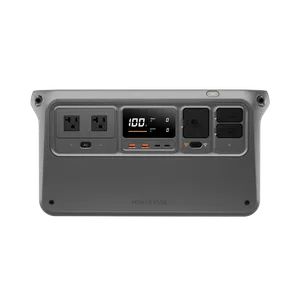
DJI built a creator’s power station, not a generalist’s: 1024Wh and 2200W of AC wrapped around the best USB-C implementation in the category (dual 140W) and SDC fast-charging for DJI drone batteries — all at a whisper-quiet 23–26 dB.
Check current price: DJI Power 1000.
Who the Power 1000 is for (and who should skip it)
Buy it if you fly DJI drones, edit on a 16” MacBook Pro, or otherwise live on USB-C. The dual 140W ports (280W combined) charge laptops and camera batteries faster than any rival here.
Skip it as a general home-backup box: no built-in MPPT (solar needs a bolt-on module), no expansion, only 2 AC outlets, and a 5-year warranty that trails the class only in paperwork. The Anker C1000 and DELTA 3 Plus are more flexible all-rounders.
USB-C done right
Most stations offer 100W USB-C as an afterthought. DJI’s dual 140W PD 3.1 ports are a genuine differentiator for creators — a MacBook Pro, camera batteries and a drone charging simultaneously, no AC inverter losses. The SDC ports take it further: DJI drone batteries fast-charge directly, skipping the AC adapter entirely.
Real-world runtime examples
Usable capacity is ~85% of 1024Wh, about 870Wh:
- MacBook Pro 16” (~140W while editing): ~6 hours of timeline work.
- 12V camping fridge (~45W): ~19 hours — a day off-grid.
- DJI drone batteries (~60Wh each): roughly 10–12 full charges — a long shooting weekend.
- Camera battery charging (~30W): ~29 hours — weeks of battery top-ups.
The caveats
The missing built-in MPPT is the real compromise: solar charging requires DJI’s add-on module, which is inelegant and easy to forget on a trip. And the 4000-cycle rating’s 70% threshold means it can’t be directly compared to the 3000-cycle/80% figures elsewhere in this guide.
How it compares
Versus the Anker C1000: DJI wins on USB-C and silence; Anker wins on price, AC outlets, recharge speed and expandability. Versus the DELTA 3 Plus: EcoFlow wins on AC output and growth path; DJI wins for the drone bag. On price alone, best budget power stations lays out the value math.
The creator’s kit, priced out
The Power 1000’s pitch is the shoot, not the spec sheet: dual 140W USB-C for a MacBook Pro and camera batteries, SDC fast-charging for DJI drone batteries, 23–26 dB so it doesn’t ruin audio. A wedding videographer can run two camera battery chargers, a laptop and a monitor (~250W) for about 3.5 hours — a full ceremony and then some — in near silence.
What you give up
Two AC outlets is the tightest count here — power strips become mandatory. No expansion means 1024Wh is forever. The add-on MPPT module is a $100+ accessory that lives in a drawer until the one trip you need it. And the 4000-cycle rating’s 70% threshold makes it look better on paper than it is versus 3000-cycle/80% rivals. Buy it for the USB-C and the silence; buy anything else for general backup.
The vanlife creator’s desk
This is the sleeper use case: a van or SUV desk where the Power 1000 sits silent under the bench. Laptop on one 140W USB-C, camera batteries on the other, a 27” monitor on AC (~60W), LED panel on DC — roughly 300W total, or about 2.9 hours of full-tilt editing per charge. Recharge from the wall in 70 minutes at the coffee shop, or 800W of roof solar (with the MPPT module) for ~1.3 peak sun hours. No generator, no noise complaints, no fumes in the living space.
Bottom line
The Power 1000 is a specialist: the best USB-C and the quietest operation in the guide, built for creators who charge cameras and drones for a living. For general backup duty, the Anker C1000 or DELTA 3 Plus give you more flexibility per dollar.
Featured in our guides
- Power Station for CPAP: How Many Nights of Backup You Actually Get (2026)
- Best Budget Portable Power Stations Under $1,000 (2026)